Ally
OverviewAlly by Ila is a B2B mobile training platform designed to equip customer-facing staff in retail, hospitality, and leisure venues to recognise and respond to harassment and abuse. The product combines structured, scenario-based training with progress tracking and certification, enabling venues to achieve “Certified Safe Space” status once staff complete the programme. Designed and delivered for iOS and Android, the platform bridges digital training with visible in-venue trust signals, including certification materials and a public-facing venue map.
My Role
Information Architecture
Hi-fi Design
Design Systems
Interaction Design
Illustration & Character Design
User Flow Design
Motion Design (Rive)
Prototyping
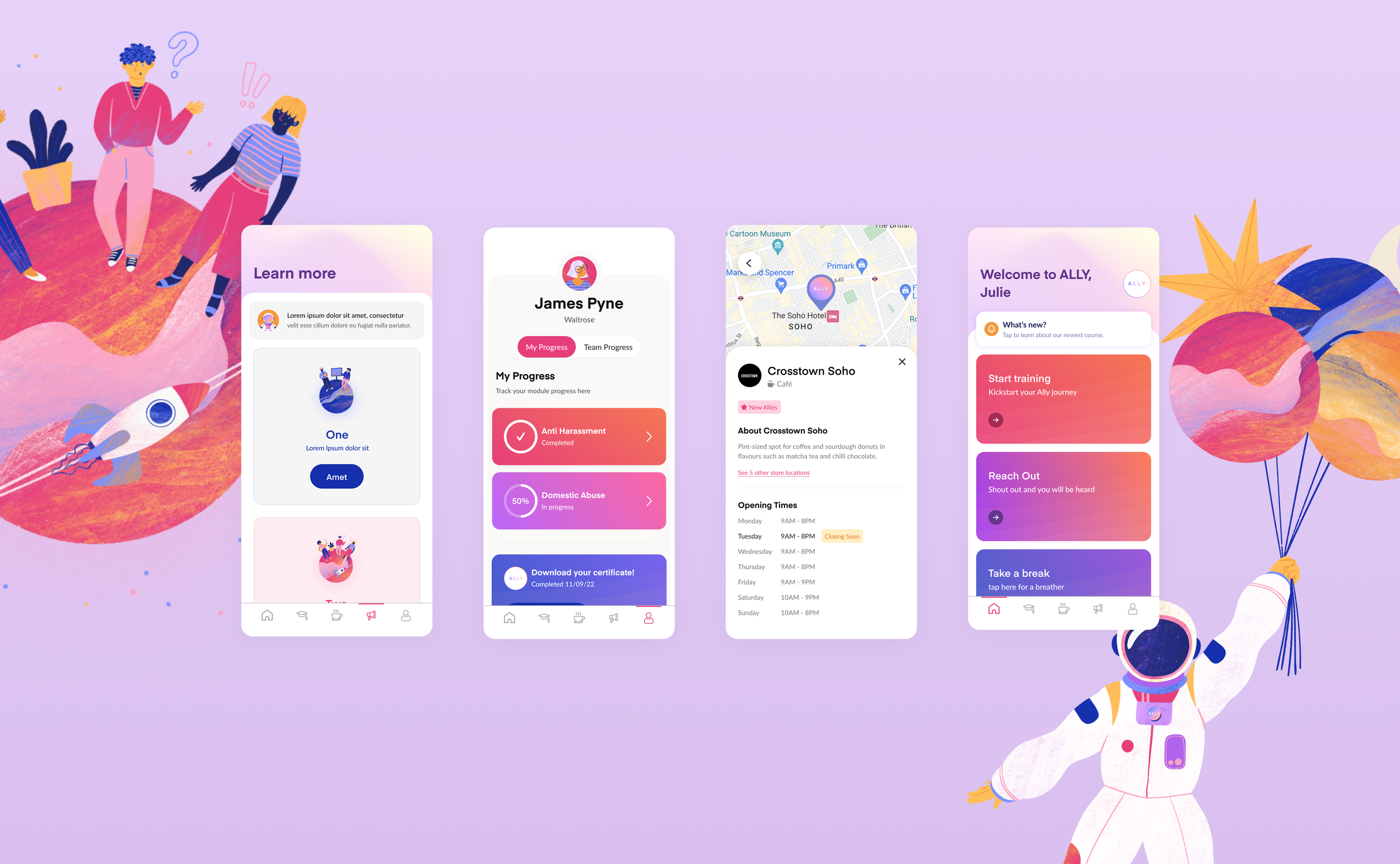
Brief
The goal was to translate sensitive and complex subject matter into a structured, practical training experience that builds confidence rather than fear. The platform needed to support two distinct user groups: frontline staff completing training modules on mobile, and venue managers overseeing compliance and certification.
The product had to balance credibility with approachability, sustain engagement across longer training flows, and function reliably under real-world conditions where trained staff may need to act quickly. It also required consistency across digital and physical touchpoints, ensuring the certification identity carried equal meaning inside and outside the app.
My Role
User Research & Personas
Qualitative research and co-design sessions were conducted with frontline retail and hospitality staff, NGO specialists, and survivors to understand both operational constraints and trauma-informed considerations. Three core personas were defined: the staff trainee, the venue manager responsible for compliance and certification, and the end beneficiary who may never interact directly with the app but whose safety the system ultimately serves. These insights shaped the tone, flow structure, and content hierarchy from the outset.
Information Architecture & User Flows
Dual-track user journeys were mapped for venue managers and staff trainees, ensuring both experiences connected meaningfully at the certification milestone. Particular care was given to the emergency resource lookup flow, treated as a standalone micro-experience designed to function quickly and reliably under real-world stress conditions. The information architecture balanced clarity for first-time users with scalability across multiple markets.
Wireframes, Prototyping & Interaction Design
Low to high-fidelity prototypes were developed across iOS and Android to explore training module structures, branching scenarios, progress tracking, and the ALLY Map. Multiple approaches were tested before landing on scenario-based interactions as the core engagement model. Iterative usability testing informed refinements to pacing, language, and flow, particularly within stress-sensitive areas such as emergency access.
Visual & UI System
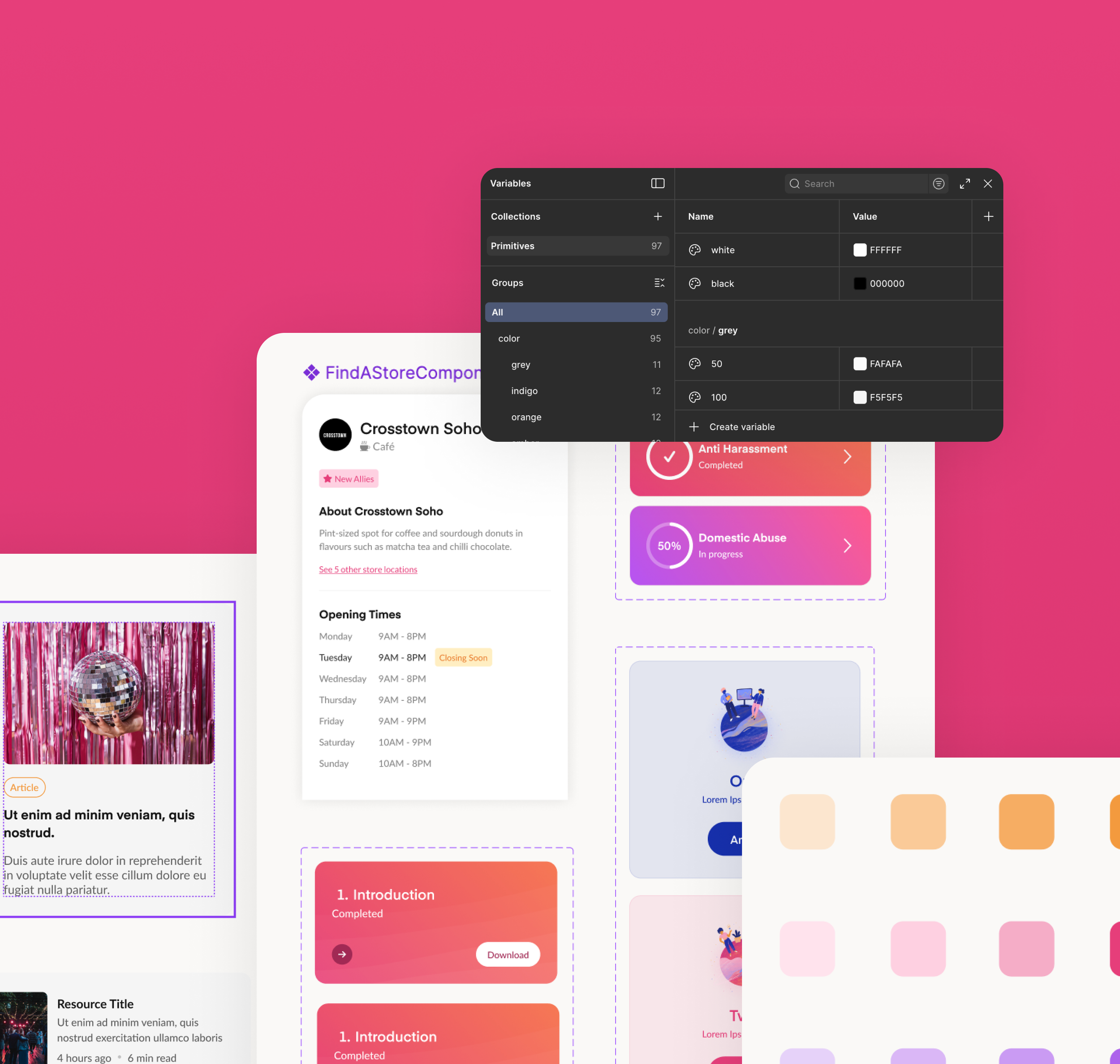
The visual identity and component system were developed to balance warmth with authority, ensuring accessibility and legibility under time pressure. A scalable design system supported consistency across digital modules and extended into physical certification materials, including window stickers, staff badges, and in-venue posters. Close collaboration with development ensured accurate implementation across both iOS and Android platforms.
Main Product Design Challanges
-
The training content addressed realistic scenarios involving harassment and abuse, requiring careful consideration of language, pacing, and user control. Interaction patterns and content structure were shaped through ongoing consultation with survivors and NGO partners to avoid retraumatisation while maintaining clarity and relevance. Trauma-informed thinking became a continuous design lens rather than a one-time validation step
-
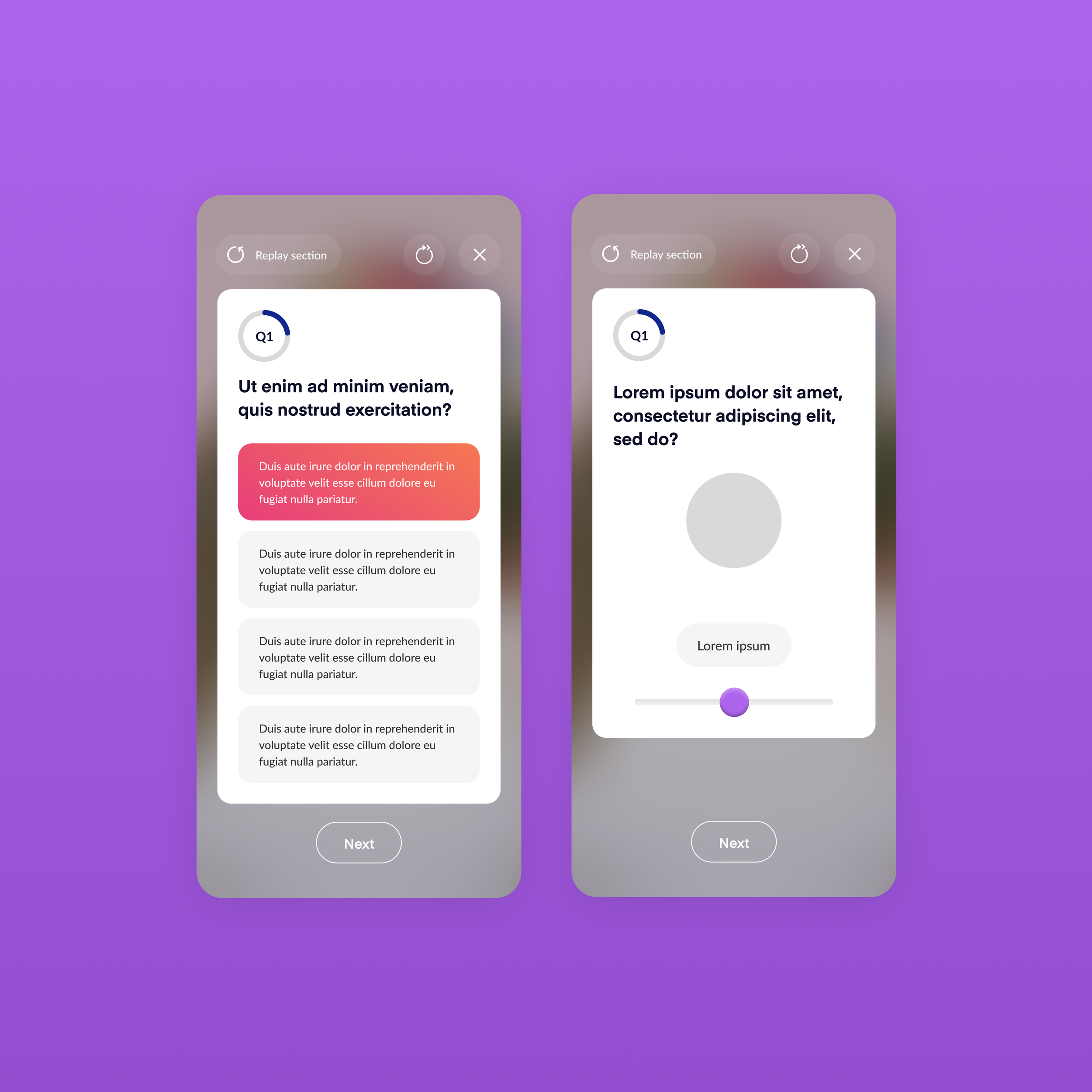
While gamification can improve completion rates, applying traditional reward mechanics to sensitive subject matter risked undermining credibility. The solution centred on branching, scenario-based interactions where users made decisions and received contextual feedback. Engagement was driven through realism and relevance rather than superficial reward systems.
-
The platform needed to serve both venue managers overseeing certification and frontline staff completing training modules in short time windows. These user groups had different motivations, constraints, and success metrics. A shared data model underpinned distinct role-based interfaces, ensuring clarity without fragmenting the product. The design system extended beyond the app into physical certification materials, reinforcing consistency between digital training and in-venue trust signals.
-
The emergency resource lookup flow had to function under stress, potentially in loud or unpredictable environments. This required simplified navigation, strong hierarchy, and minimal interaction steps. Designing for urgency rather than ideal conditions influenced several structural decisions across the app.
Impact and Outcome
Ally launched on iOS and Android in July 2021 and quickly gained traction across multiple markets. Within its initial rollout, more than 1,000 frontline staff were trained across London, Berlin, and Bangkok, demonstrating early international adoption.
The platform secured partnerships with major organisations including Adidas, Hyatt Regency Bangkok, Unilever, WeWork, Google, and Sephora Thailand, alongside formal MOUs with five major companies in Thailand, including the Hyatt Regency Group. Ally was featured by UN Women Asia-Pacific, and its co-founder Net Supatravanij received the UN Women Youth Leadership Award for Thailand and was named 2nd runner-up at the inaugural WEPs Awards, led by UN Women and the UN Global Compact.
Government partnerships were established with the Thai Ministry of Social Development and Human Security and the Department of Women’s Affairs and Family Development, signalling institutional confidence in the platform’s approach. The product was also shortlisted for the Seedstars × UN ESCAP Smart Cities Innovation Lab, with a proposed city-wide pilot in Chiang Mai.