Match My Project
OverviewMatch My Project is a web-based SaaS marketplace built by civic tech startup Firesouls to put the UK Social Value Act 2012 into practice. The legislation required public bodies to consider wider social benefits in procurement, but there was no real mechanism for delivering or measuring those commitments. SVE filled that gap with a credit-based e-auction model built directly into procurement workflows.
The platform connects contracting authorities, suppliers bidding for public contracts, and community organisations delivering grassroots projects, turning social value from a policy requirement into a measurable, scalable system adopted by major councils including Kent County Council and Birmingham City Council.
My Role
Information Architecture
Hi-fi Design
Design Systems
Interaction Design
Illustration & Character Design
User Flow Design
Motion Design (Rive)
Prototyping
Brief
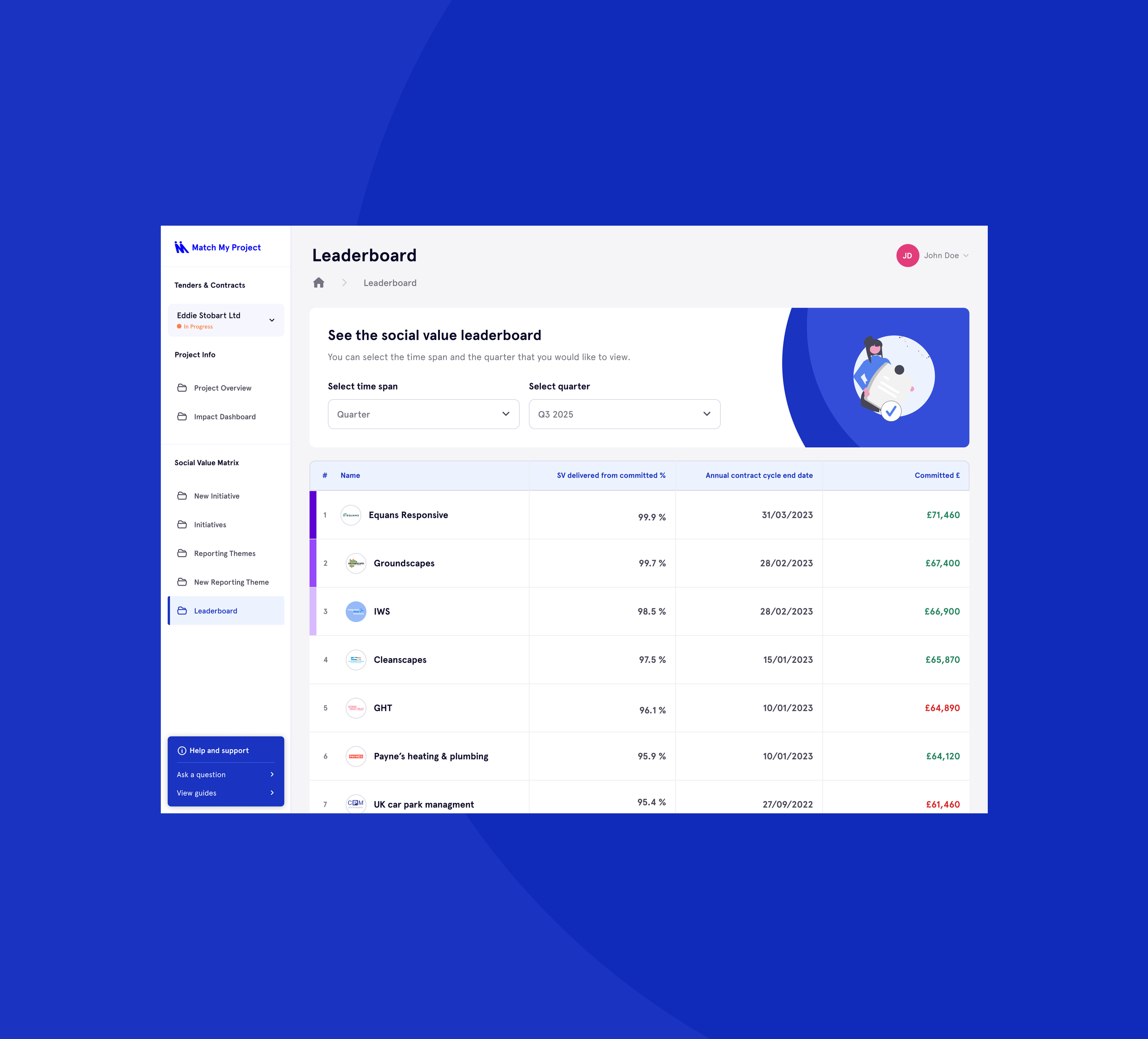
The project aimed to design a clear and scalable dashboard experience within a structurally complex three-sided marketplace. The platform needed to support councils overseeing procurement frameworks, suppliers competing in social value auctions, and community organisations seeking access to resources, each operating within different workflows, incentives, and levels of digital confidence.
The objective was to translate abstract procurement mechanics, including Social Value Credits, competitive e-auctions, accreditation dependencies, and post-transaction reporting, into intuitive role-based interfaces. Clarity, accountability, and scalability were central to the brief, ensuring the system could function reliably within high-value public procurement environments.
My Role
Discovery & Experience Definition
Three core user groups were identified early: procurement officers, suppliers, and small community organisations. Research focused on their distinct needs, from oversight and bidding motivations to onboarding constraints. Working closely with the founders helped make sure the legal and procurement requirements were reflected clearly in the product's flows. This shaped the initial user journeys and clarified how accreditation, auction participation, and reporting states fit together within the system.
Information Architecture & User Flows
The dashboard needed to work for three quite different user groups, all operating within the same underlying data model. User flows were defined for onboarding, auction creation and participation, filtering and discovery, reporting, and resource verification.
With a high volume of sensitive procurement data to present, information hierarchy was a priority. Progressive disclosure was used to surface the most important signals first, with the option to dig deeper where needed. The goal was to make things feel simpler without stripping out the detail that mattered.
Wireframing & Interaction Prototyping
Wireframes were used to validate navigation, auction mechanics, and dashboard clarity before any visual design was introduced. Interactive prototypes in Figma then tested the bidding interactions, credit allocation logic, and how information was shared across different user roles.
Translating the e-auction model into an intuitive interaction pattern took particular care. Social Value Credits and competitive resource pledging needed to feel transparent and fair, while staying compliant with procurement standards.
Design System and High-Fidelity UI
A design system was built to support consistency and make the product easier to scale over time. Foundational elements including typography, spacing, colour, variables, and reusable components were established during the transition from wireframes to high-fidelity UI.
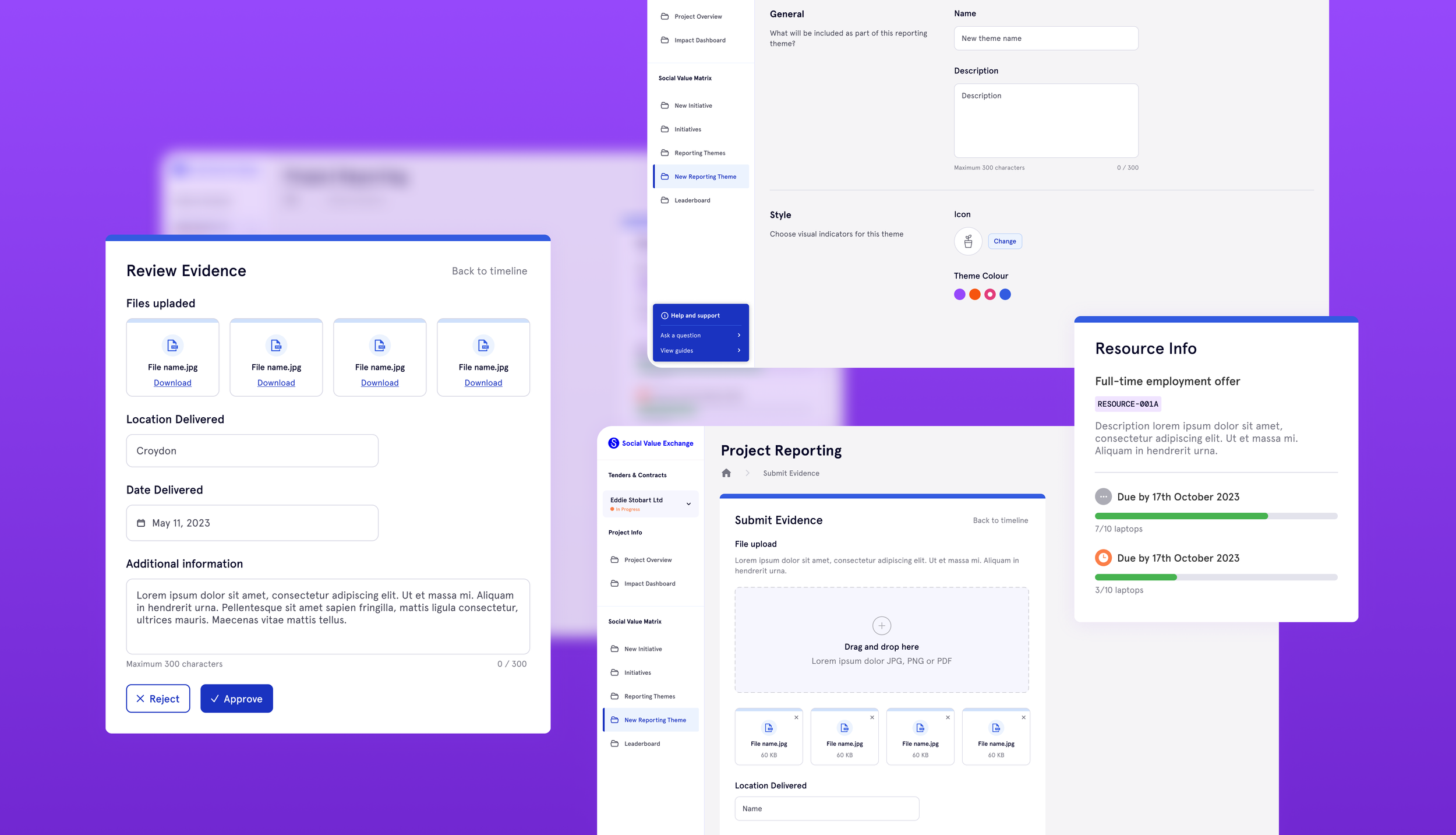
Components were built to cover dashboards, data tables, filters, status indicators, and reporting modules. Colour was used semantically to communicate auction states, accreditation progress, and reporting signals, rather than for branding. Close collaboration with the developer throughout ensured a smooth handoff and reduced guesswork during implementation.
Key product design chalanges
-
Unlike a typical two-sided platform, SVE had to balance the needs of councils, suppliers, and community organisations at the same time. Each group operated under different constraints and incentives. Designing distinct but coherent role-based experiences on a shared data structure required continuous prioritisation and careful system thinking.
-
Social Value Credits and competitive resource pledging are not widely understood concepts. The interaction model needed to make bidding feel intuitive while keeping procurement transparency and compliance intact. Simplification couldn't come at the cost of rigour.
-
Councils and housing associations needed oversight across multiple contracts, suppliers, and community projects. Presenting that volume of information without overwhelming users required disciplined hierarchy, structured layouts, and strong visual clarity.
-
Credibility depended on confirming that pledged resources were actually delivered. Post-auction reporting and verification flows needed to be clearly structured to support accountability and measurable impact across procurement cycles.
A principle that emerged through iteration was that clarity drives engagement. The simpler the process, the more likely stakeholders were to participate meaningfully.
Platform evolution
Pilot Stage (2015–2016)
Initial launch with Genesis Housing Association on a £20m contract generated £450K in community resources, proving viability.
Growth (2017–2021)
Backed by Nesta’s ShareLab Fund. Expanded across London boroughs and major housing associations. Kent County Council adoption leveraged up to £2bn procurement spend.
Maturation (2022–Present)
Awarded the CIPS Award for Best Initiative to Deliver Social Value through Procurement. Birmingham City Council designated SVE as its primary channel for delivering Social Value commitments. Continued national expansion through 2026.
Impacts and Outcome
£222
in social value generated for every £1 passing through SVE
£2 billion
in procurement spend leveraged through the platform
646
community projects supported in a single year
2000
active community organisations supported
9910
hours of business time contributed
Match My Project grew from a pilot to national adoption. The initial 2015 pilot with Genesis Housing Association on a £20 million contract generated £450,000 in community resources, proving the model worked. From there it expanded across London boroughs and major housing associations. By the end of 2025 the platform had engaged 1,900 suppliers, facilitated 1,600 connections, and unlocked an estimated £761,000 in funding and in-kind support within a single year. The platform received the Chartered Institute of Procurement and Supply award for Best Initiative to Deliver Social Value through Procurement.
From a product perspective, Match My Project showed how structured UX, clear dashboard design, and solid information architecture can turn complex legislation into a functioning, measurable civic system at scale.