TooWrite
OverviewTooWrite is a web-based academic writing platform designed to support researchers in producing structured, publication-ready abstracts and journal papers. Rather than generating text for users, the product guides them through a proven academic writing framework, breaking complex writing tasks into manageable stages.
Designed for a diverse research community, from PhD students to senior academics, the platform addresses both the structural and emotional challenges of academic writing. The core design challenge lay in translating this framework into an intuitive, calm interface that supports long-form writing, structured planning, and sustained cognitive effort without overwhelming the user.
Lorem ipsum dolor sit amet
My Role
UX Design
Interaction Design
UI Design
Wireframing
Information Architecture
Prototyping (Figma)
User Flow Design
Usability Testing
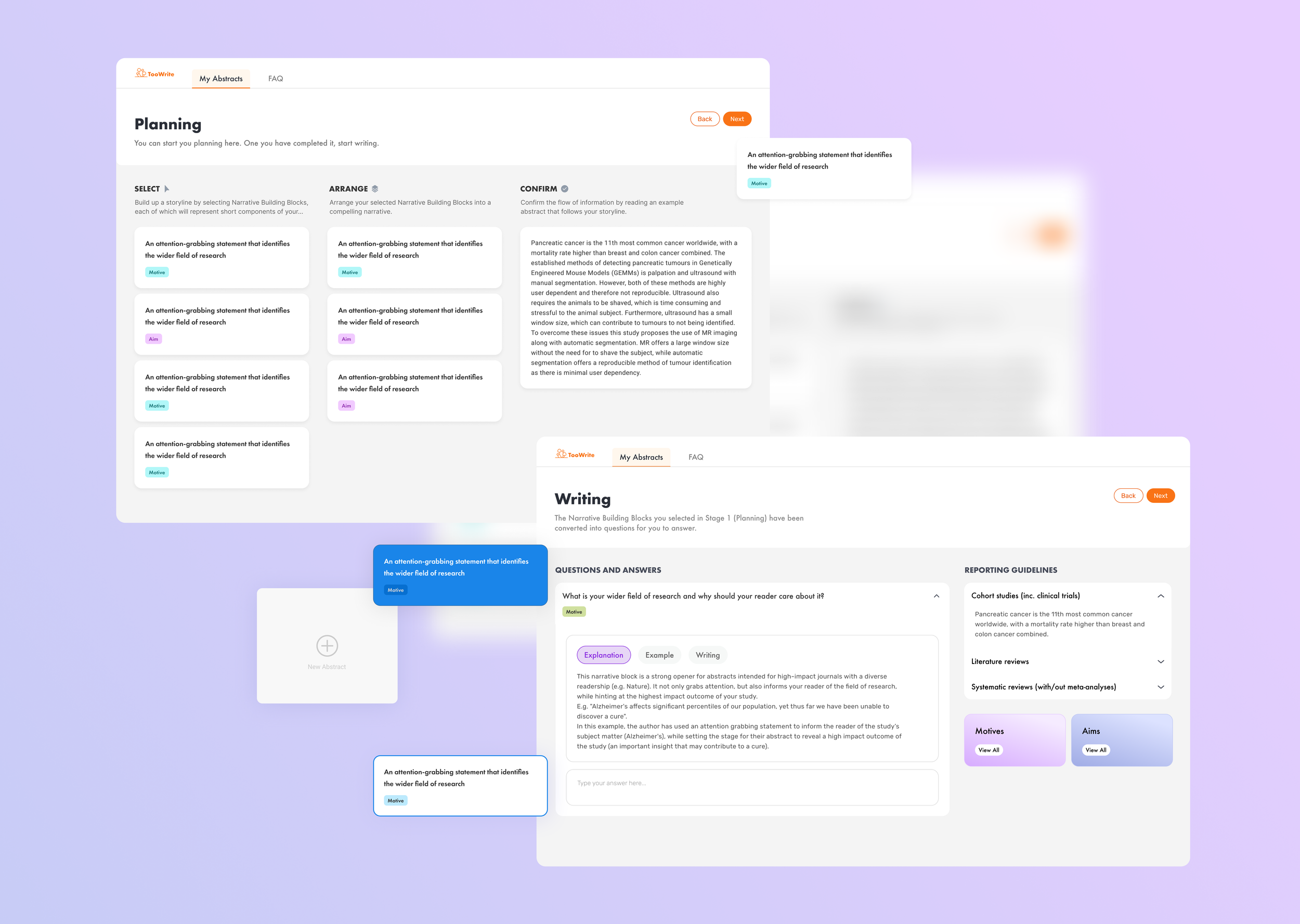
TooWrite was developed to address a persistent gap in academic training. Scientific papers follow highly structured and repeatable patterns, yet researchers are rarely taught how to approach writing them. As a result, producing an abstract can take weeks, and a full paper can take months or longer, not because the science is unclear, but because the writing process lacks structure and support.
The platform was built for the global research community, from PhD students to senior academics, including researchers working in a second or third language. The goal was to design a web-based system that made the underlying structure of scientific writing explicit and usable, guiding researchers step by step through the process while maintaining ownership of their work. The challenge was to translate a structured writing model into an intuitive digital experience that reduced friction without oversimplifying the craft.
Brief
My Role
User Research & Problem Framing
I led qualitative research with scientists across partner institutions to understand both the structural and emotional barriers within the academic writing process. Interviews with researchers at different career stages revealed where confidence broke down, where friction occurred, and how writing anxiety manifested. These insights shaped the sprint-based interaction model and informed the integration of mental health support directly within the writing flow.
Information Architecture & User Flows
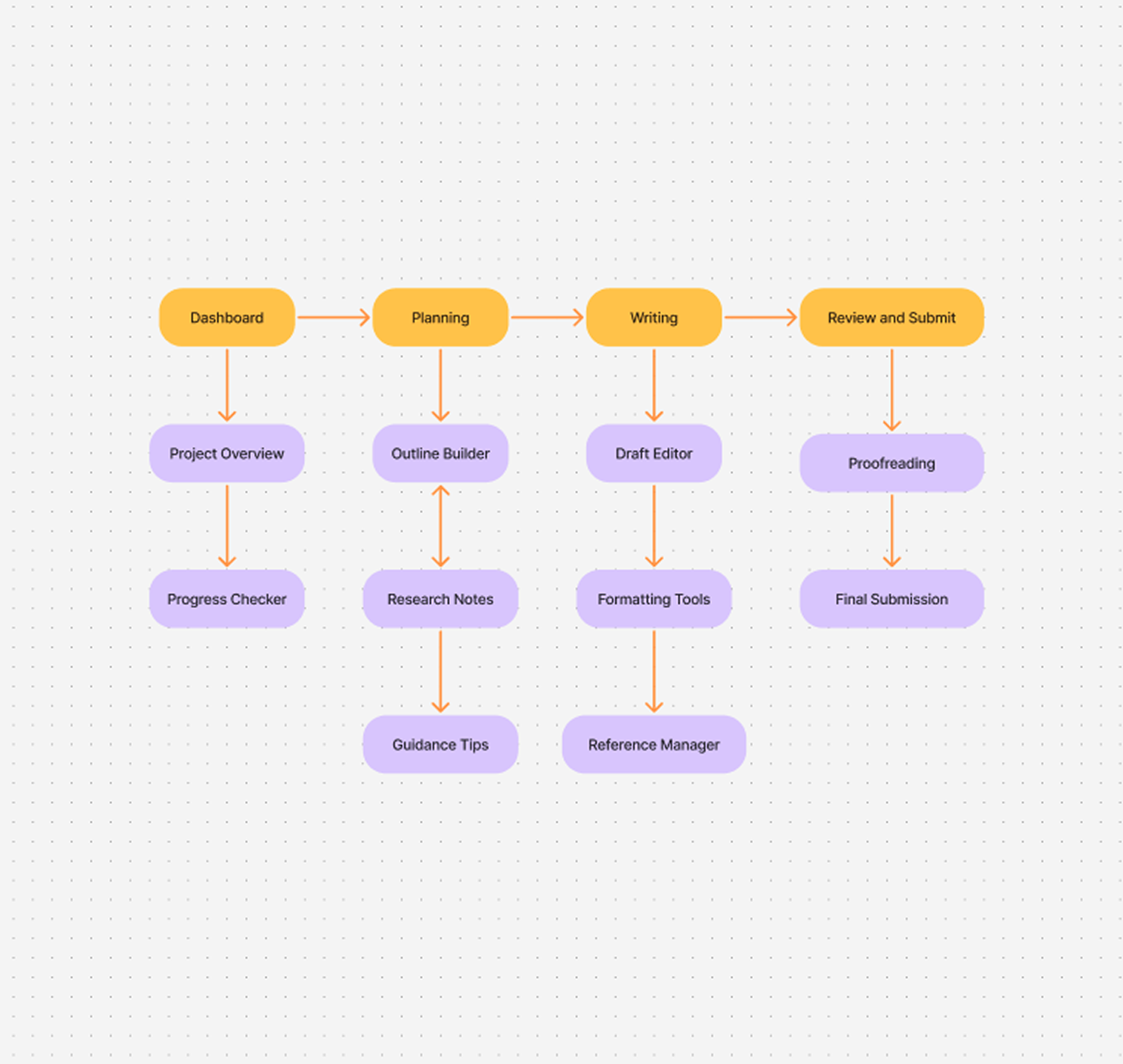
I defined the core information architecture and user journeys for both the abstract and full paper modules, mapping the path from onboarding through to draft export. A key focus was sequencing the narrative-building phase in a way that felt empowering rather than restrictive. Multiple flow iterations were tested to ensure clarity, momentum, and logical progression across complex writing stages.
Prototyping, Interaction & UI Design
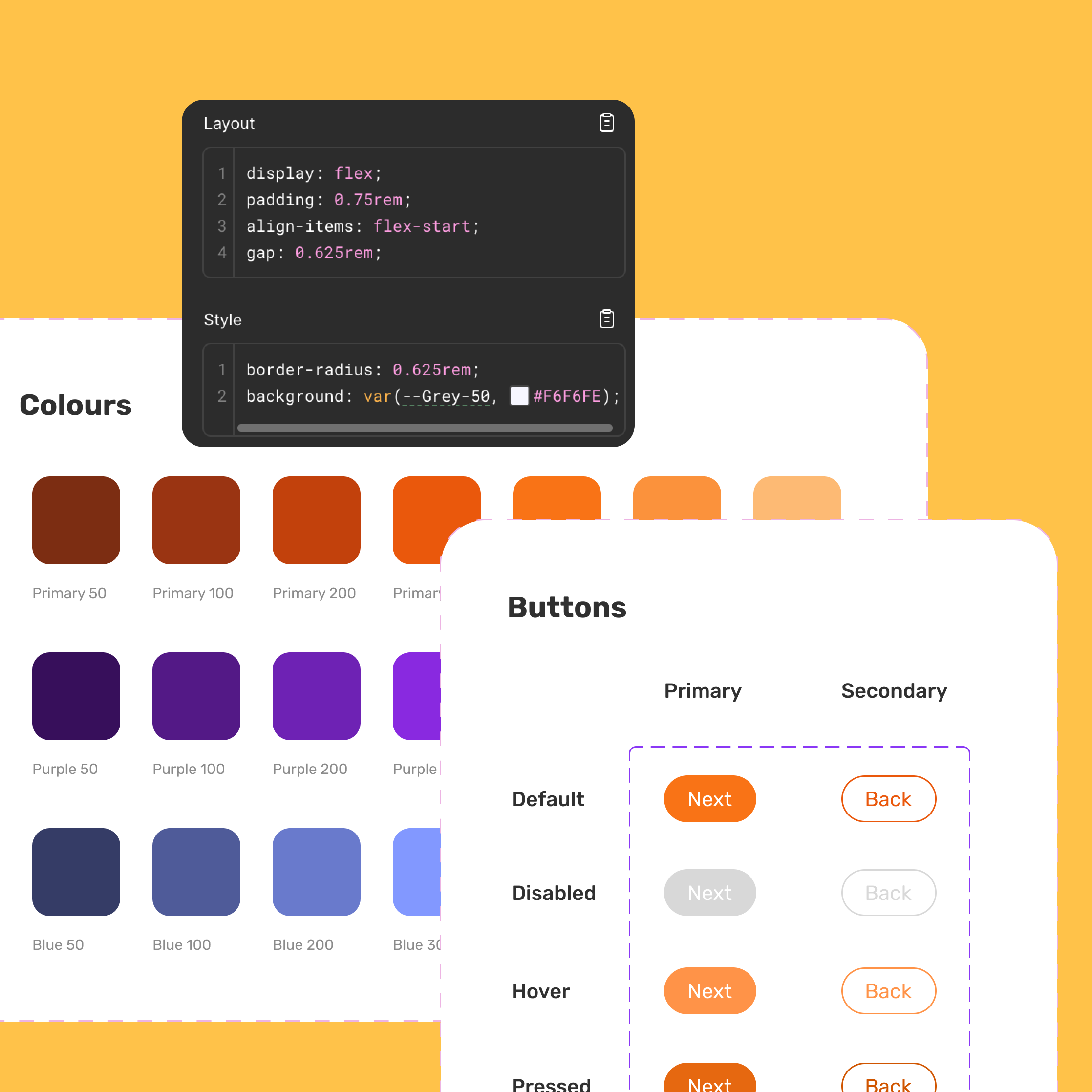
Low-fidelity wireframes and interactive prototypes were used to validate hierarchy, pacing, and usability before visual styling was introduced. I owned the visual and interaction design of the platform, creating a calm and credible interface suited to long-form writing. Typography, spacing, and microcopy were carefully considered to reduce cognitive load and support sustained focus. Close collaboration with developers ensured design intent translated accurately into production, particularly around long-form text handling, browser constraints, and performance across extended writing sessions.
Iteration, Testing & Refinement
Interactive prototypes were tested with target users throughout development to validate decision points and refine interaction patterns. Usability sessions informed multiple revisions, particularly around narrative selection and sprint pacing, until the experience felt structured without being constraining. This iterative approach ensured that each feature was validated before release.
Main Product Design Challanges
-
TooWrite is built on the premise that scientific writing follows recognisable patterns. However, many researchers associate good writing with originality and personal expression. The core design challenge was to present structured guidance in a way that felt enabling rather than limiting. This required careful iteration of language, framing, and interaction patterns to ensure users experienced the framework as a tool for clarity rather than constraint.
-
The two-to-four sentence sprint model broke long writing tasks into short, focused units. Designing this interaction required careful consideration of pacing, feedback, and progress signalling. The experience needed to create momentum without feeling patronising, particularly for senior academics. Iterative testing helped calibrate how completion, progression, and small wins were communicated across different user groups.
-
TooWrite embedded DBT-based mental health tools directly into the writing process. The challenge was ensuring these interventions felt contextual and supportive rather than intrusive. Language and placement were carefully considered so that support mechanisms appeared at moments of friction without interrupting flow or pathologising normal writing anxiety.
-
The platform served users ranging from early-career PhD students to senior professors, and from native English speakers to researchers writing in a second or third language. A single interface needed to remain clear and credible across all groups. This influenced decisions around vocabulary, examples, depth of guidance, and interface complexity to ensure the system scaled without fragmenting into multiple products.
Impact and Outcome
TooWrite Abstracts launched in open beta in March 2022 and was piloted at four UK universities. Institutional testing exceeded initial targets by 200 to 300 percent across engagement and completion metrics, indicating strong alignment between the product model and user needs.
The platform secured partnerships with multiple academic institutions and research organisations, demonstrating viability across different university environments and IT constraints. In February 2023, TooWrite was acquired by Springer Nature and integrated into its Research Solutions portfolio, providing external validation of both the product approach and its practical relevance within academic publishing.
Beyond commercial outcomes, the project demonstrated that complex, emotionally demanding workflows can be improved through structured interaction design. By combining clear information architecture with supportive micro-interactions, the platform reduced friction in a traditionally high-stress process and established a scalable foundation for continued iteration.